%20--%3e%3csvg%20version='1.1'%20id='Layer_1'%20xmlns='http://www.w3.org/2000/svg'%20xmlns:xlink='http://www.w3.org/1999/xlink'%20x='0px'%20y='0px'%20viewBox='0%200%2085%2015.9'%20style='enable-background:new%200%200%2085%2015.9;'%20xml:space='preserve'%3e%3cdefs%3e%3clinearGradient%20id='dfGrad'%20gradientUnits='userSpaceOnUse'%20x1='0'%20y1='8'%20x2='85'%20y2='8'%3e%3cstop%20offset='0'%20stop-color='%231CA57F'/%3e%3cstop%20offset='1'%20stop-color='%233FC0BC'/%3e%3c/linearGradient%3e%3c/defs%3e%3cstyle%20type='text/css'%3e%20.st0{fill:%23FFFFFF;}%20.st1{fill:url(%23dfGrad);}%20%3c/style%3e%3cg%3e%3cg%3e%3cpath%20class='st1'%20d='M2,13.8L8.2,2.6h1L3,13.8H2z'/%3e%3cpath%20class='st1'%20d='M7,13.8l6.2-11.2h1L8.1,13.8H7z'/%3e%3cpath%20class='st1'%20d='M15,13.2l2.2-11h3.3c1.2,0,2.2,0.4,2.9,1.3c0.8,0.9,1,2,0.7,3.3l-0.4,1.8c-0.3,1.4-0.9,2.6-1.7,3.3%20c-0.9,0.8-1.9,1.2-3.2,1.2H15z%20M19.1,3.9l-1.5,7.6h1.6c0.6,0,1.2-0.3,1.6-0.8c0.4-0.5,0.7-1.2,0.9-2.1L22,6.9%20c0.2-0.9,0.1-1.6-0.3-2.1c-0.4-0.5-0.9-0.8-1.6-0.8H19.1z'/%3e%3cpath%20class='st1'%20d='M27.8,13.2h-2.2l2.2-11H30L27.8,13.2z'/%3e%3cpath%20class='st1'%20d='M38.7,11.7c-0.4,0.4-1,0.8-1.7,1.2c-0.7,0.3-1.6,0.5-2.5,0.5c-1.2,0-2.1-0.4-2.8-1.3%20c-0.7-0.8-0.9-1.9-0.6-3.2l0.5-2.3c0.3-1.4,0.9-2.5,1.8-3.3s2-1.2,3.2-1.2c1.2,0,2.1,0.3,2.6,1c0.6,0.7,0.8,1.5,0.7,2.6l0,0h-2%20c0-0.6-0.1-1.1-0.3-1.4s-0.6-0.5-1.2-0.5c-0.6,0-1.1,0.3-1.6,0.8c-0.5,0.5-0.8,1.2-1,2l-0.5,2.3c-0.2,0.9-0.1,1.6,0.1,2.1%20c0.3,0.5,0.7,0.7,1.4,0.7c0.4,0,0.8-0.1,1.1-0.2c0.3-0.1,0.5-0.2,0.7-0.4l0.4-2h-1.7l0.3-1.5h3.9L38.7,11.7z'/%3e%3cpath%20class='st1'%20d='M43.2,13.2H41l2.2-11h2.2L43.2,13.2z'/%3e%3cpath%20class='st1'%20d='M52.8,8h-4.9l-1,5.1h-0.9l2.2-11h6.5L54.5,3h-5.7L48,7.3h4.9L52.8,8z'/%3e%3cpath%20class='st1'%20d='M54.9,12.4h5l-0.2,0.8h-5.9l2.2-11h0.9L54.9,12.4z'/%3e%3cpath%20class='st1'%20d='M68.9,8.6c-0.3,1.5-0.9,2.7-1.7,3.5c-0.8,0.8-1.8,1.2-3,1.2c-1.1,0-2-0.5-2.7-1.4s-0.8-2-0.5-3.4l0.4-1.8%20c0.3-1.5,0.9-2.7,1.6-3.5c0.8-0.8,1.8-1.2,3-1.2c1.1,0,2.1,0.5,2.7,1.4s0.9,2,0.6,3.4L68.9,8.6z%20M68.4,6.8%20c0.2-1.2,0.1-2.2-0.3-2.9c-0.5-0.7-1.2-1.1-2.2-1.1c-0.9,0-1.6,0.4-2.3,1.1s-1.1,1.7-1.3,2.8l-0.4,1.8c-0.3,1.3-0.2,2.2,0.3,2.9%20c0.5,0.7,1.2,1.1,2.2,1.1c0.9,0,1.7-0.4,2.3-1.1c0.7-0.7,1.1-1.7,1.3-2.9L68.4,6.8z'/%3e%3cpath%20class='st1'%20d='M72.5,10.1l0,1.6l0,0l0.6-1.6l3.4-7.9h0.8l0.9,7.9l0.1,1.6l0,0l0.6-1.6l3.1-7.9H83l-4.4,11h-0.8l-0.9-8.4%20l-0.1-1.1l0,0l-0.4,1.1l-3.6,8.4h-0.8l-0.9-11H72L72.5,10.1z'/%3e%3c/g%3e%3c/g%3e%3c/svg%3e)
Service Management with Matrix42
Service management that improves everyday operations
Good service management creates clarity. Employees know where to request support, service teams work with defined responsibilities, and routine activities follow consistent processes.
Requests reach the right team with the information required to act. Progress remains visible, responsibilities are clear, and service data shows where demand, delays and recurring issues occur.
Matrix42 brings these capabilities together in one service management platform, providing a structured foundation for efficient and reliable service delivery.
Explore the benefits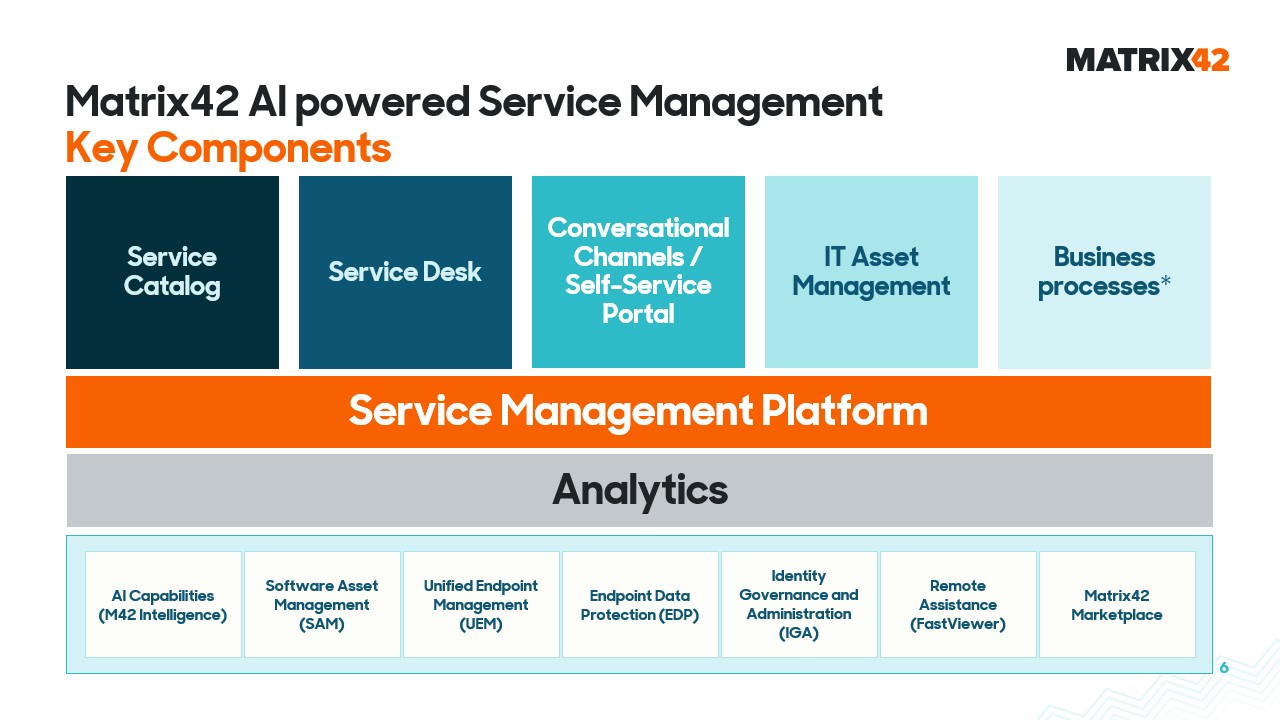 © Matrix42
Give service teams more time for work that matters
A significant part of service delivery is coordination. Requests need to be reviewed, assigned and approved. Information has to be collected, updates must be communicated, and work often moves across several teams.
When these activities rely on email, spreadsheets and individual knowledge, they consume valuable time and make service quality difficult to maintain.
Matrix42 brings requests, approvals, knowledge and workflows into a controlled process. Routine activities move forward with less manual coordination, while specialists focus on complex issues, service improvements and work that requires experience and judgement.
This improves the use of service resources without adding unnecessary process overhead.

Keep requests moving
Reliable service delivery depends on clear ownership and consistent execution.
When responsibilities are unclear, requests remain in inboxes, handovers take longer and employees have little visibility into progress. Service teams spend additional time following up instead of resolving the request itself.
Defined workflows establish what happens at each stage, who is responsible and when action is required. Requests remain visible from submission through fulfilment, and everyone involved understands the next step.
The result is a more predictable service experience and fewer delays between teams.

Make it easy to get help
Employees should not need to understand the internal structure of the organization before they can request a service.
A clear service catalog provides a simple point of access. Relevant knowledge helps employees resolve common questions independently, while guided forms collect the information required to process each request.
This improves the quality of incoming requests and reduces avoidable clarification. Employees spend less time searching for the right contact, and service teams begin their work with better information.
Good self service does not remove human support. It ensures that people reach the right support more quickly.

Understand where time and effort go
Consistent processes create reliable service data.
Teams see which services generate the most demand, where requests slow down and which issues occur repeatedly. They can compare workload, response times, fulfilment times and service levels across different areas.
This turns reporting into a practical management tool. It provides a clear basis for deciding where to simplify a process, improve knowledge, adjust responsibilities or address a recurring cause of work.
Instead of focusing only on the number of closed tickets, service owners gain a better understanding of service performance and improvement priorities.

See the full context behind each request
Effective service management depends on context.
A request rarely exists in isolation. It relates to a person, a device, an application, a location or a business service. Without this information, service teams spend additional time searching across systems and confirming basic details.
By connecting service requests with asset, software and endpoint information, Matrix42 places the relevant operational context alongside the issue.
Teams see who is affected, which technology is involved and whether a wider business service is at risk. This supports faster diagnosis, more informed decisions and better coordination between service and technical teams.
It also creates a more accurate view of the organization’s technology environment.

Automate routine service work
Automation creates the most value when it is applied to frequent, predictable and clearly defined activities.
Access requests, software requests, standard approvals, onboarding tasks, equipment requests and routine notifications are typical examples. These processes often involve the same sequence of checks, decisions and updates.
Matrix42 coordinates these steps through defined workflows. Tasks are routed, approvals are triggered, responsibilities remain visible and the process is documented throughout.
People remain involved where expertise, judgement or exception handling is required. The objective is not to automate every interaction. It is to remove repetitive work from processes where the value is clear.
AI extends this approach by supporting knowledge search, request classification and resolution. Applied selectively, it improves access to information and reduces the effort behind common service activities.

Extend service management beyond IT
The principles of service management apply wherever employees request internal services.
HR, Facilities, Procurement, Finance and other functions manage requests for access, equipment, documents, approvals and information. In many organizations, these services still depend on shared inboxes, separate forms and spreadsheets.
This creates an inconsistent experience for employees and limited transparency for service owners.
A common service management approach introduces clear entry points, defined responsibilities, traceable workflows and meaningful service data. Each department keeps the processes it needs, while employees benefit from a more consistent way to request and receive internal services.
Matrix42 provides a shared foundation without forcing every business function into an identical operating model.

Grow with the needs of the organization
Service management develops over time. Processes mature, responsibilities become clearer and new requirements emerge.
Matrix42 supports this progression from core IT service management to broader service processes, automation, asset management and Enterprise Service Management.
Expansion follows a clear business case. The organization improves the areas that matter now and introduces additional capabilities when they provide operational value.
This approach keeps change manageable, protects process quality and prevents the platform from becoming more complex than the organization requires.

At a glance
Where good Service Management makes a difference
Streamlined administration
Standard activities follow defined processes and require fewer manual handovers.
Predictable service delivery
Clear ownership and consistent workflows keep requests moving from submission to fulfilment.
Easy access to support
Employees know where to request a service, what information to provide and what to expect.
Operational visibility
Service data reveals demand, delays, recurring issues and opportunities for improvement.
Effective use of specialist expertise
Experienced employees focus on complex issues, service quality and continuous improvement.
Consistent foundation for growth
The same service management principles extend to additional teams and services as requirements develop.

Let’s Talk
Bring clarity to Service Management
Every organization is at a different stage of service management maturity. DigiFlow helps shape, implement and extend Matrix42 in line with strategic priorities and operational needs.
Aiming for strong processes, sustainable service operations and measurable improvement? Let’s get in touch.